
Military, Veteran & First Responder Therapy in Carlsbad, California
Virtual therapy services offered throughout California, Colorado, and the U.S. Virgin Islands
Very few people will ever truly understand what your job has asked of you.
You've been asked to carry responsibilities most people will never have to imagine. To make impossible decisions in impossible moments. To stay calm while everyone around you is falling apart. To run toward danger when every instinct tells the rest of us to run away.
Those experiences don't simply disappear when the uniform comes off, the shift ends, or the pager goes quiet.
Sometimes they change the way you sleep.
The way you love.
The way you trust.
The way you see the world.
The hardest part is that many of the skills that made you exceptional at your job, compartmentalizing, staying hyperaware, pushing through pain, carrying the weight without complaint, don't always serve you once you're home.
My hope isn't to take away those strengths.
It's to help you carry them without letting them carry you.
Maybe this sounds familiar...
Maybe you've become so good at compartmentalizing that you aren't even sure what's locked away anymore.
You know how to function. You know how to get the job done. You know how to push through exhaustion, carry the weight, and keep moving because that's what the mission, the call, or the team requires. Somewhere along the way, you stopped asking yourself how you were doing. Maybe because it didn't feel important. Maybe because it didn't feel safe. Or maybe because you genuinely didn't know anymore.
You tell yourself you're fine because someone else had it worse. You'd rather crack a joke than answer honestly when someone asks how you're doing.
You've gotten so used to carrying difficult things quietly that asking for help feels far more uncomfortable than continuing to carry them.
Maybe you spent months overseas making life-or-death decisions, only to come home and wonder why standing in the grocery store suddenly felt surreal. Or maybe you've spent years walking into burning buildings, horrific accidents, overdoses, suicides, abused children, or medical emergencies, only to clock out at the end of your shift and be expected to slip seamlessly back into being a spouse, a parent, or a friend.
People often imagine the hardest part is what happens on deployment, on scene, or during the call.
In my experience, that's only part of the story.
Sometimes the hardest part is coming home.
It's sitting at your child's soccer game while your mind is somewhere else. It's lying in bed exhausted but unable to sleep. It's realizing you're constantly scanning crowds, parking lots, rooftops, or exits without even thinking about it. It's snapping at the people you love most because your nervous system has forgotten what it feels like to truly stand down.
And perhaps the hardest part of all is this:
The qualities that made you exceptional at your job, your discipline, your hypervigilance, your ability to compartmentalize, your willingness to sacrifice yourself for others, are often the very qualities that make it hardest to ask for help.
Why This Work Matters To Me
People often ask why I feel so drawn to military members, veterans, and first responders. The truth is, I don't remember ever making that decision. For more than a decade, I lived alongside military life. I witnessed the pride, the purpose, the sacrifice, and the kind of loyalty that most people will never fully understand.
I also witnessed something else: the invisible cost that service can carry long after the deployment ends, the shift is over, or the uniform comes off.
I watched trauma follow someone home. Sometimes it looked like hypervigilance. Sometimes it looked like anger that didn't seem to fit the moment. Sometimes it looked like emotional distance, sleepless nights, or trying to outrun memories that refused to stay in the past. And sometimes it looked like someone convincing themselves they were fine simply because everyone around them was carrying the same weight.
What struck me most wasn't only what trauma did to the individual. It was what it did to the people who loved them. I watched spouses desperately trying to reconnect with someone who was physically home but emotionally still somewhere else. I watched children trying to understand why Mom or Dad seemed different. I watched entire families quietly reorganize themselves around wounds no one else could see.
That experience changed the trajectory of my life.
I became determined to understand trauma so thoroughly that I would never sit across from someone carrying those invisible burdens and wonder what to do next. I wanted to understand why the brain changes after overwhelming experiences, why the body continues reacting to danger long after the danger has passed, and why people who are deeply loved can still feel profoundly alone.
More importantly, I wanted to know what actually helps people heal.
That pursuit led me to advanced trauma training in EMDR and Brainspotting. It led me to spend years studying the nervous system, attachment, and the lasting effects of trauma, not because trauma work was becoming popular, but because I had already seen what happens when it goes untreated. I had seen too many good people believe they simply had to carry it forever.
Perhaps the greatest lesson military life taught me is that strength and suffering can exist in the very same person. Some of the strongest people I've ever met have also carried unimaginable grief, guilt, fear, loss, and loneliness. Those realities don't cancel each other out. If anything, they often exist side by side.
That's why I approach this work with such deep respect. I don't see broken people sitting across from me. I see people whose nervous systems adapted exactly as they were designed to under extraordinary circumstances. My job isn't to erase those experiences or diminish the strength it took to survive them. My job is to help ensure that survival isn't the only way they know how to live anymore.
Because I've seen what trauma can take.
I've also seen what healing can give back.
I've watched people sleep through the night after years of nightmares. I've watched marriages reconnect. I've watched parents become emotionally present with their children again. I've watched people laugh without forcing it, trust themselves again, and slowly discover that life can become bigger than what happened to them.
That's why I do this work.
Not because I studied trauma.
Because I witnessed what it costs when good people carry it alone.
How I Approach Trauma Therapy for Military Members, Veterans & First Responders in Carlsbad

One of the greatest strengths of military members and first responders is the ability to keep moving when everyone else freezes. Discipline, compartmentalization, dark humor, self-sacrifice, and staying calm under unimaginable pressure are often what allow people to do these jobs exceptionally well.
Those aren't flaws.
They're remarkable adaptations.
The challenge is that what keeps you alive on the battlefield or during a critical incident doesn't always help you connect with your spouse, your kids, or yourself once you're home.
That's why I don't believe therapy is about taking away those strengths.
It's about helping your nervous system learn when those protective strategies are still necessary and when they can finally rest.
Clinically, I use trauma-focused approaches including EMDR, Brainspotting, and Cognitive Processing Therapy (CPT), depending on what you’re carrying and what fits you best. EMDR and Brainspotting can help process experiences that remain stuck in the nervous system, while CPT offers a structured way to work with the beliefs trauma can leave behind, including guilt, self-blame, safety, trust, control, and what you believe you should have done differently. I also draw from Internal Family Systems (IFS)-informed work to understand the protective parts of you that developed for good reason, Acceptance and Commitment Therapy (ACT) to help you move toward the life you want even when difficult emotions are present, and Solution-Focused Therapy to build on the resilience you've already demonstrated throughout your life and career.
We're not simply talking about what happened.
We're helping your nervous system learn that the danger isn't happening anymore.
Military-informed care matters
Working with military members, veterans, and their families requires more than understanding PTSD. Military culture, deployment, reintegration, identity, relationships, and the realities of service all shape what happens in the therapy room.
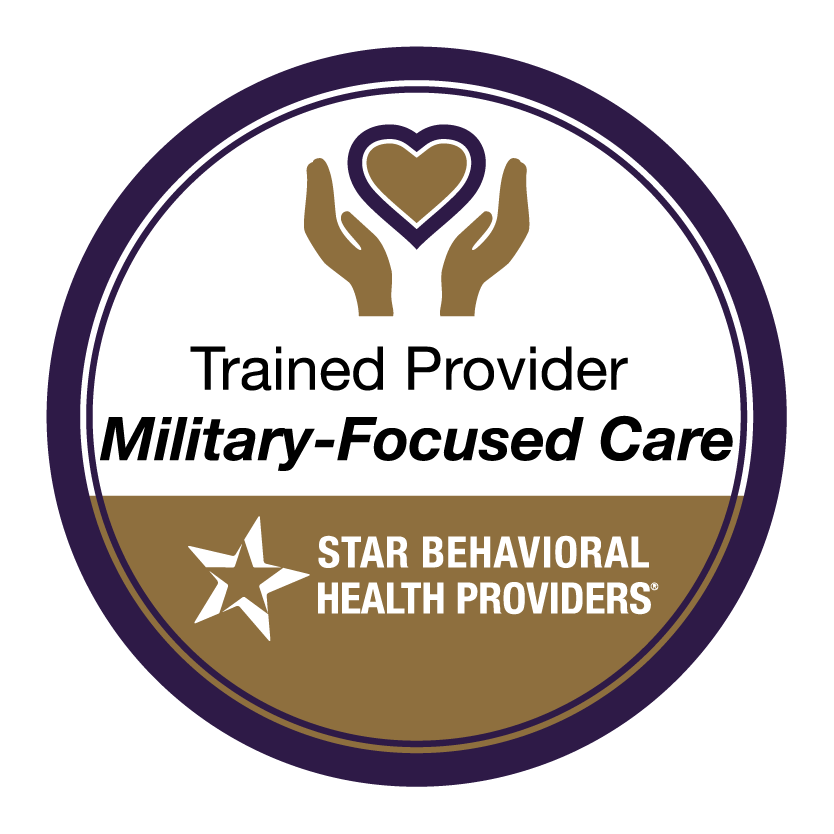
I have completed specialized military behavioral health training through STAR Behavioral Health Providers and am listed in the STAR Behavioral Health Providers Directory, a national resource designed to connect military-connected individuals and families with civilian clinicians who have completed specialized training in military behavioral health.
The Thing No One Talks About
One of the things I've noticed after working with military members, veterans, and first responders is that the people who have experienced the most are often the least likely to call it trauma. Instead, I hear things like, “It was just part of the job.” “Everybody saw that.” “Other guys had it way worse than I did.” “It doesn't bother me.”
Sometimes that's true. Sometimes it isn't.
What I've learned is that this community rarely struggles because they're unwilling to face hard things. Quite the opposite. They've spent entire careers walking toward the very things the rest of us spend our lives hoping we'll never encounter. The issue has never been courage. If anything, courage is something this community has in abundance.
The challenge is that somewhere along the way, many have been taught, either directly or indirectly, that acknowledging what they've seen, endured, or carried somehow diminishes the strength it took to survive it. That admitting something changed them means they've somehow become weaker than the person who first put on the uniform or answered the call.
I don't believe that for a second.
And the truth is, we don't even have to call it trauma if that word doesn't fit. Call it the call you'll never forget. The deployment that changed something in you. The child you couldn't save. The friend who didn't make it home. The accident scene that still shows up when you're trying to fall asleep. The split-second decision you replay in your mind years later, wondering if there was something-anything-you could have done differently.
Call it whatever feels honest.
The label matters far less than what it's costing you.
If what you've experienced has stolen your sleep, your peace, your relationships, your patience, your ability to relax, or your ability to feel fully present with the people you love, then it's worth paying attention to. Not because you're weak. Not because you've failed. Because you're human.
One of the greatest privileges of my work has been watching people who once believed, "This is just who I am now," slowly discover that it isn't. I've watched nightmares become less frequent, hypervigilance begin to soften, and people reconnect with spouses, children, and parts of themselves they thought were gone forever. I've watched people laugh again without forcing it and realize that healing doesn't require forgetting what happened. It simply means that what happened no longer gets to dominate every room you walk into.
You don't have to convince me that what happened to you was "bad enough." If it's changed the way you move through the world, it's important enough for us to talk about.
You will never hear me ask you to erase your experiences. Those experiences are part of your story, and in many ways, they've shaped the person you've become.
My hope is simply that they stop writing every chapter that comes next.

What would it feel like to finally come home?
Not just physically.
Emotionally.
Mentally.
In your own body.
Imagine walking into your house after work and actually arriving there. Not sitting on the couch while part of your mind is still replaying the call, the scene, the deployment, or the decision you made years ago that somehow still follows you around.
Imagine your children remembering you for the way you laughed with them instead of the way you lost your patience over things that were never really the problem. Imagine your spouse no longer feeling like they have to guess which version of you is walking through the front door. Imagine being able to sit in a crowded restaurant with your back to the door because your nervous system no longer believes it has to protect everyone in the room.
Imagine hearing fireworks and simply thinking, "Someone's celebrating."
Imagine driving past the intersection where that fatal accident happened without your chest tightening before you even realize why.
Imagine finally being able to close your eyes at night without replaying the faces, the sounds, the smells, or the moments you've spent years trying to outrun. Not because you've forgotten them, but because they no longer hijack your nervous system every time they show up.
Imagine discovering that the edge you've lived on for years isn't actually your personality. It was your nervous system doing exactly what it was designed to do: keeping you alive.
And imagine realizing that it can learn something new.
I can't promise you'll never think about what you've seen.
I can't promise there won't be days that still feel heavy.
What I can tell you is that I've watched people stop merely surviving their own lives. I've watched them sleep through the night after years of nightmares. I've watched them reconnect with the people they love, laugh without forcing it, and discover that healing doesn't mean becoming someone different. It means finally having enough room inside yourself to become the person you were always meant to be, beyond what the job required of you.
You have spent your career protecting other people.
You deserve the chance to experience that same kind of care yourself.
I'd be honored to walk beside you while you find your way there.

Meet Your Carlsbad Military, Veteran & First Responder Therapist
CHELSEA ROUSH, LPCC
Trauma Therapist
Hi! I’m Chelsea Roush, a trauma therapist specializing in work with military members, veterans, first responders, and adults navigating trauma, PTSD, and the lasting impact of high-stress experiences.
I understand that in these worlds, functioning well doesn’t necessarily mean you’re doing well. You can be exceptionally capable under pressure and still find that your nervous system has no idea how to stand down once the danger, deployment, shift, or mission is over.
My approach is warm, direct, and grounded in respect for the ways you learned to survive. The goal isn’t to take away the parts of you that made you capable. It’s to help your nervous system recognize when those protective strategies are still necessary and when they can finally rest.
Insight illuminates the path. Action carries you home.
Questions I hear most often…
No therapy jargon. No sugarcoating. Just honest answers to the questions I hear every day.
-
This might be one of the biggest fears I hear.
Many military members and first responders worry that if they finally start talking about what they've carried, everything they've spent years holding together will come crashing down.
That's not how trauma therapy works.
You don't have to relive every deployment, every call, every accident, or every loss to heal from it. We move at a pace your nervous system can actually tolerate. Healing isn't about flooding yourself with painful memories. It's about helping your brain and body realize they don't have to keep reliving them to keep you safe.
-
I understand that fear.
Many people worry that healing will somehow make them softer, less aware, or less capable of doing their job.
In my experience, the opposite is often true.
Healing doesn't take away your instincts, your discipline, or your ability to perform under pressure. It helps your nervous system recognize the difference between when you're actually in danger and when you're finally safe enough to stand down.
The goal isn't to make you less effective.
It's to make sure the job doesn't continue costing you more than it has to.
-
One of the biggest misconceptions about trauma is that it always announces itself dramatically.
Sometimes it does. Other times it quietly becomes the reason you don't sleep as deeply, trust as easily, laugh as often, or feel as present with the people you love.
If you're asking whether it's "just the job," I'd encourage you to ask a different question: What has the job cost me?
Because that's usually where the answer lives.
-
That's a fair question.
If you've spent any amount of time in the military or as a first responder, there's a good chance you're sizing me up before we've even exchanged more than a few words. You're probably wondering whether I understand your world well enough that you won't have to spend half the session explaining acronyms, military culture, or why gallows humor exists. You may even be wondering whether I'm going to flinch when you tell me what you've seen, what you've done, or what you've had to carry.
I understand that.
Trust isn't something I expect from this community simply because I have letters behind my name. Trust is earned. That’s how it should be.
I don't shock easily. I'm not afraid of the dark parts of being human, and I'm certainly not interested in judging you for the ways you've survived. My job isn't to decide whether what you've experienced was "bad enough." My job is to understand how it's living inside you today and to help you loosen its grip.
If you spend the first session quietly deciding whether I'm full of shit, I won't take it personally.
I'd probably do the same.
What I can promise is that I'll show up prepared. I'll respect your experience. If I don't know something, I'll tell you. If I do know something, I won't use it to prove myself. I'd much rather spend our time understanding your story than trying to convince you I belong in it.
Most of all, I want you to know this: you don't have to protect me from your story. After years of working with military members and first responders, I've learned that some of the heaviest stories are often carried by the people who talk about them the least. I don't scare easily, I don't judge, and I'm not going to ask you to water down your experiences to make them easier for me to hear.
If you decide to trust me with your story, you'll find someone who's calm enough to hold it, curious enough to understand it, and experienced enough to know where we go from there.
-
That's an incredibly important question, especially if you work in the military, law enforcement, fire service, EMS, or another profession where you're responsible for the safety of others. Many people hesitate to seek therapy because they're worried about what a diagnosis could mean for their career, future opportunities, specialized assignments, or professional reputation.
One of the reasons I intentionally chose to build a private-pay practice is because it allows us to have those conversations without automatically involving an insurance company. When insurance is billed, a mental health diagnosis is generally required for reimbursement. As a private-pay practice, I don't submit claims to insurance, which means I don't have to assign a diagnosis simply so your sessions can be covered.
That doesn't mean diagnoses never matter. Depending on your profession, employer, licensing requirements, military status, or specific circumstances, there are situations where a diagnosis or mental health treatment may have implications. I never want to minimize that reality or offer blanket reassurance that isn't true.
Instead, we'll have an honest conversation about your particular situation before making assumptions. My goal is to help you understand your options so you can make an informed decision, not one driven by fear, misinformation, or worst-case scenarios.
-
Both! I offer in-person sessions at my Carlsbad office and virtual therapy throughout California, Colorado, and the U.S. Virgin Islands. Our work can include trauma-focused therapy, EMDR, and Brainspotting for experiences such as PTSD, cumulative trauma, moral injury, and the lasting effects of high-stress work or service.

Ready to Start Military, Veteran or First Responder Therapy in Carlsbad, California?
You learned how to function in survival mode. You don’t have to live there forever.
A free consultation is a chance to talk about what’s bringing you here, ask questions, and see whether working together feels like the right fit. You don’t need to know exactly where to begin. We can figure that part out together.